
Focus Group Discussions in Malaysia: How to Get Real Insights, Not Just Surface Opinions
Mar
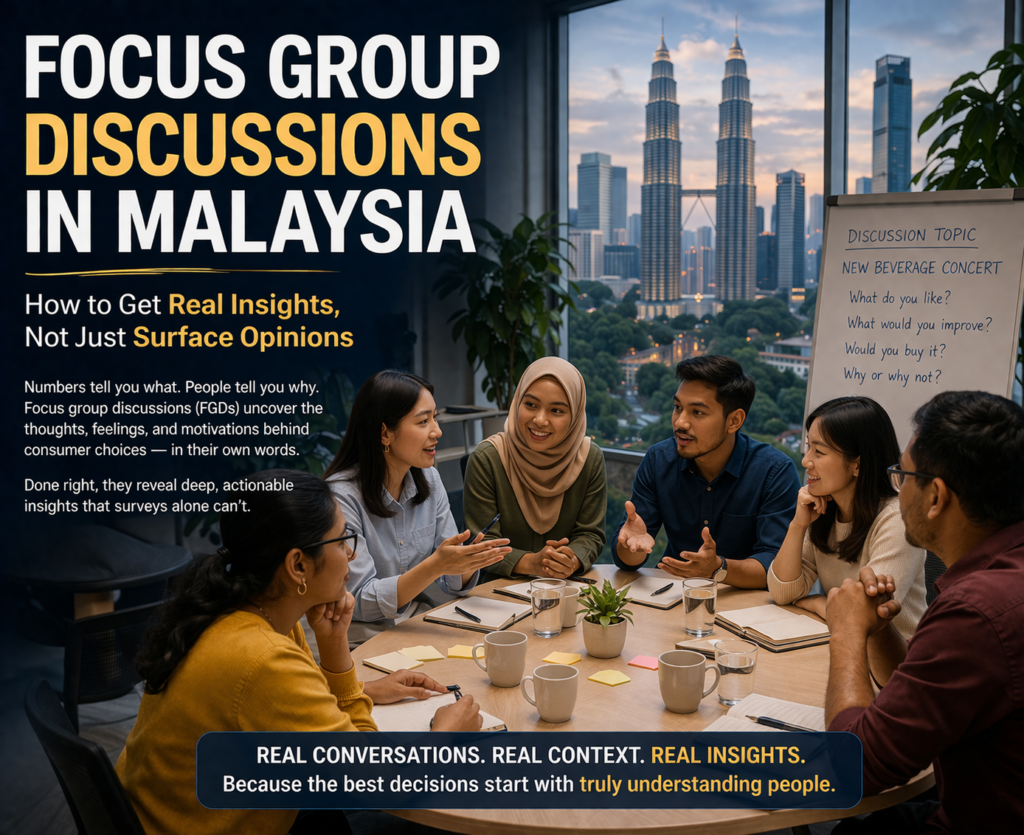
Focus group discussions are one of the most commonly used qualitative research methods[cite: 111]. They are often chosen because they allow researchers to hear directly from consumers, observe reactions in real time, and explore ideas in greater depth[cite: 112]. But not all focus groups deliver meaningful insights[cite: 113]. In many cases, what is captured are surface-level opinions rather than true underlying motivations[cite: 114]. The difference comes down to how the session is designed, moderated, and interpreted[cite: 115].
What Focus Groups Are Actually Good For
Focus groups are not designed to produce statistically representative results[cite: 117]. Their value lies in depth, not scale[cite: 118]. They are most effective when used to:
- Explore perceptions and attitudes [cite: 120]
- Understand decision-making processes [cite: 121]
- Test concepts, messaging, or ideas [cite: 122]
- Identify language and narratives used by consumers [cite: 123]
They help answer the question “why”, rather than “how many”[cite: 124].
The Risk of Group Dynamics
One of the defining features of focus groups is also one of their biggest challenges[cite: 126]. Participants do not respond in isolation; they influence each other[cite: 127]. This can lead to:
- Dominant individuals shaping the conversation [cite: 129]
- Quieter participants holding back their views [cite: 130]
- Participants adjusting responses to align with the group [cite: 131]
In some cases, consensus may appear stronger than it actually is[cite: 132]. Without careful moderation, the discussion can drift towards agreement rather than genuine diversity of opinion[cite: 133].
The Role of the Moderator Is Critical
A well-run focus group depends heavily on the moderator[cite: 135]. The moderator is not just guiding the conversation, but actively managing participation balance across respondents, the flow and depth of discussion, and the neutrality of the session[cite: 136, 137, 138, 139]. A strong moderator will encourage quieter participants to speak, manage dominant voices without shutting them down, and probe beyond initial answers to uncover deeper motivations[cite: 140, 141, 142, 143]. The goal is not to get quick answers, but to explore what sits behind them[cite: 144].
Asking the Right Questions
The quality of a focus group is often determined by the discussion guide[cite: 146]. Questions should be designed to start broad and gradually narrow, avoid leading or suggestive phrasing, and encourage storytelling rather than short answers[cite: 147, 148, 149, 150]. For example, instead of asking if a participant likes a product, it is more effective to ask for their first reaction or how they would describe it to someone else[cite: 151, 152]. These types of questions reveal more natural and meaningful responses[cite: 153].
Cultural Context in Malaysia Matters
In Malaysia, cultural dynamics can influence how participants behave in group settings[cite: 155]. Some participants may be more reserved in expressing disagreement, avoid giving negative feedback openly, or look to others before sharing their own views[cite: 156, 157, 158, 159]. This makes it important to create a comfortable environment, use moderators who understand local nuances, and structure sessions to encourage individual expression[cite: 160, 161, 162, 163]. Without this, certain perspectives may remain unspoken[cite: 164].
Group Composition Affects Outcomes
Who is in the room matters as much as what is discussed[cite: 166]. Mixing participants with very different backgrounds can lead to imbalanced discussions or difficulty relating to each other’s experiences[cite: 167, 168, 169]. Conversely, overly similar groups may limit diversity[cite: 170]. A well-structured focus group typically considers age range, socioeconomic background, and usage behaviour relevant to the topic[cite: 171, 172, 173, 174]. Segmenting groups properly allows for clearer and more relevant insights[cite: 175].
From Discussion to Insight
One of the common pitfalls in focus group research is stopping at what was said[cite: 177]. The real value lies in interpretation, which involves identifying recurring themes, understanding emotional drivers, and distinguishing between stated opinions and underlying motivations[cite: 178, 179, 180, 181, 182]. For instance, a participant may say a product is “better quality,” but the deeper question is whether that means durability, taste, or brand perception[cite: 183, 184, 185, 186, 187]. This level of interpretation turns discussion into insight[cite: 188].
When to Use Focus Groups
Focus groups are particularly useful for:
- Early-stage exploration of consumer attitudes [cite: 191]
- Testing concepts or creative materials [cite: 192]
- Understanding perceptions before launching a product [cite: 193]
- Complementing quantitative findings with deeper context [cite: 194]
They are less effective when used as a standalone method for decision-making that requires scale or measurement[cite: 195].
Closing Thoughts
Focus groups remain a powerful tool when used correctly, providing access to how consumers think, not just what they do[cite: 197, 198]. But their effectiveness depends on execution[cite: 199]. Without the right structure, moderation, and interpretation, they risk capturing only what is easy to say, rather than what truly matters[cite: 200]. When done well, they offer insights that cannot be captured through surveys alone[cite: 201].
About Central Force International Sdn Bhd
Central Force International (CFI) is Malaysia’s leading homegrown market research agency, specialising in comprehensive data collection services since 1996[cite: 203]. As a trusted partner and member to global organisations such as ESOMAR and WAPOR, we are dedicated to delivering high-quality, ethical, and impactful research insights[cite: 203]. With in-house teams for data processing, quality control, and research, CFI ensures every project meets the highest standards of excellence[cite: 204]. Guided by our core values—Ethics, Quality, Care—we empower clients with reliable data to drive informed decisions across diverse industries[cite: 205]. Visit us at www.cforce-int.com to learn more[cite: 206].