
Online Surveys in Malaysia: When They Work — and When They Don’t
Mar
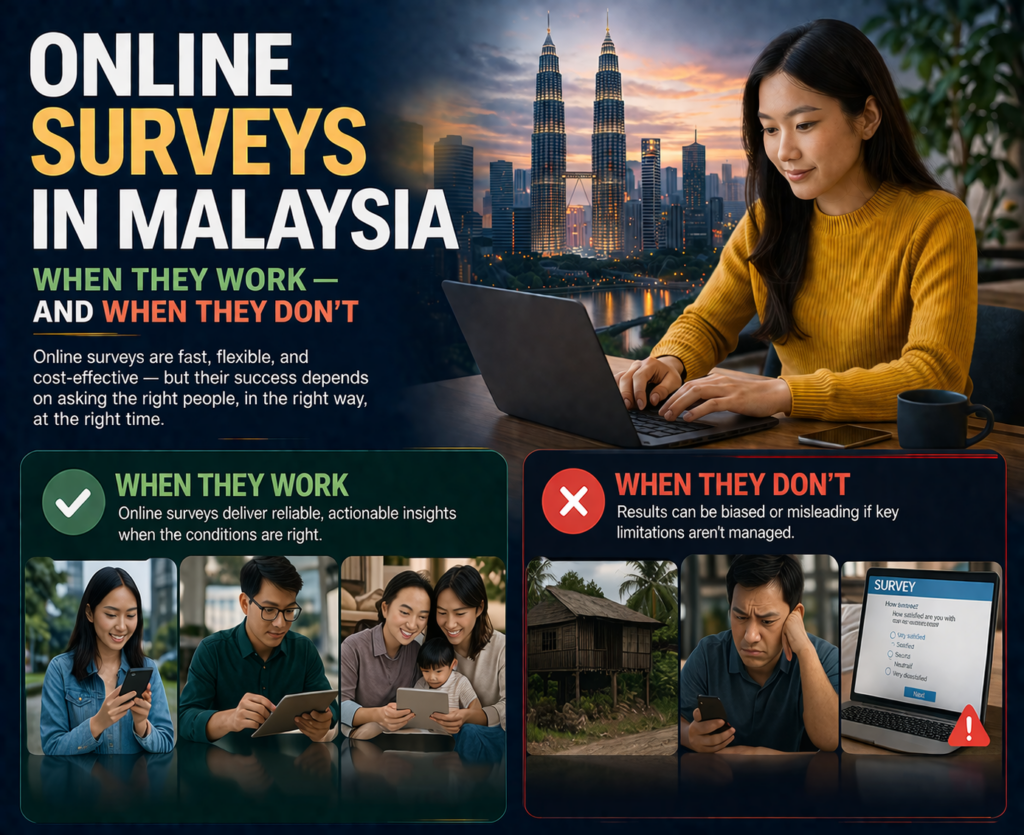
Online surveys have become one of the most widely used tools in market research. They are fast, scalable, and relatively cost-efficient. For many projects, they are the default starting point. However, treating online surveys as a one-size-fits-all solution can lead to blind spots. In Malaysia, where digital adoption is high but not uniform, understanding when online surveys work—and when they fall short—is critical.
Why Online Surveys Are So Widely Used
The appeal of online surveys is straightforward. They allow researchers to:
- Reach large numbers of respondents quickly
- Deploy surveys across multiple regions simultaneously
- Reduce operational costs compared to interviewer-led methods
- Iterate and test concepts in shorter cycles
For many commercial studies, especially those focused on trends or early-stage exploration, this makes online surveys highly effective.
Where Online Surveys Perform Well
Online surveys are particularly suited for audiences that are already digitally engaged. This typically includes:
- Urban populations
- Younger demographics
- Consumers active on e-commerce or social platforms
They are also effective for studies such as brand tracking among target segments, concept or campaign testing, customer satisfaction surveys, and quick pulse checks on emerging trends. In these scenarios, the objective is often directional insight rather than full population representation.
The Hidden Risk: Sample Bias
Despite their advantages, online surveys come with an inherent limitation: they only reach people who are already online and willing to participate. This creates a natural bias towards more digitally active individuals and those familiar with survey formats. In Malaysia, this can result in under-representation of older populations, rural communities, and less digitally engaged segments.
Engagement Is Not Guaranteed
Without an interviewer present, respondents may skim through questions, provide patterned answers, or drop off before completion. These behaviours affect data quality. To manage this, online surveys require additional controls such as:
- Attention checks within the questionnaire
- Time tracking to identify rushed responses
- Data cleaning to remove inconsistent entries
Screening Is More Difficult to Enforce
Online screening is more rigid than interviewer-led methods. Respondents may misinterpret questions or provide inaccurate answers to qualify for the study. This is particularly challenging for niche audiences, such as specific decision-makers. Extra care is needed in designing screening logic and validation steps.
When Online Surveys Are the Right Choice
Online surveys work best when the target audience is clearly defined and digitally accessible, speed is a priority, and budget constraints are a consideration. They are especially useful for tracking changes over time, testing multiple ideas quickly, and gathering feedback from existing customer bases.
When Online Surveys May Fall Short
Situations where relying solely on online surveys can create risk include:
- Nationwide studies requiring demographic representativeness
- Research involving less digitally active populations
- Topics that require explanation or probing
- Studies where data accuracy is critical for decision-making
Designing Better Online Surveys
The effectiveness of online research depends heavily on design. Key considerations include keeping questionnaires concise, using clear and simple language, structuring questions to minimise confusion, and embedding quality checks. Good design helps reduce the impact of inherent limitations.
The Role of Online Surveys in Modern Research
Online surveys are becoming part of a broader toolkit rather than replacing traditional methods. In many Malaysian projects, hybrid designs are used where online surveys provide scale, while other methods ensure representativeness and data quality.
Closing Thoughts
Online surveys remain one of the most powerful tools in market research, but their value depends on how they are used. Understanding their strengths and limitations allows businesses to apply them more effectively. When aligned with the right objectives, they deliver fast insights; when misapplied, they can create confidence in data that does not fully reflect reality.
About Central Force International Sdn Bhd
Central Force International (CFI) is Malaysia’s leading homegrown market research agency, specialising in comprehensive data collection services since 1996. As a trusted partner and member to global organisations such as ESOMAR and WAPOR, we are dedicated to delivering high-quality, ethical, and impactful research insights. With in-house teams for data processing, quality control, and research, CFI ensures every project meets the highest standards of excellence. Guided by our core values—Ethics, Quality, Care—we empower clients with reliable data to drive informed decisions across diverse industries. Visit us at www.cforce-int.com to learn more.