
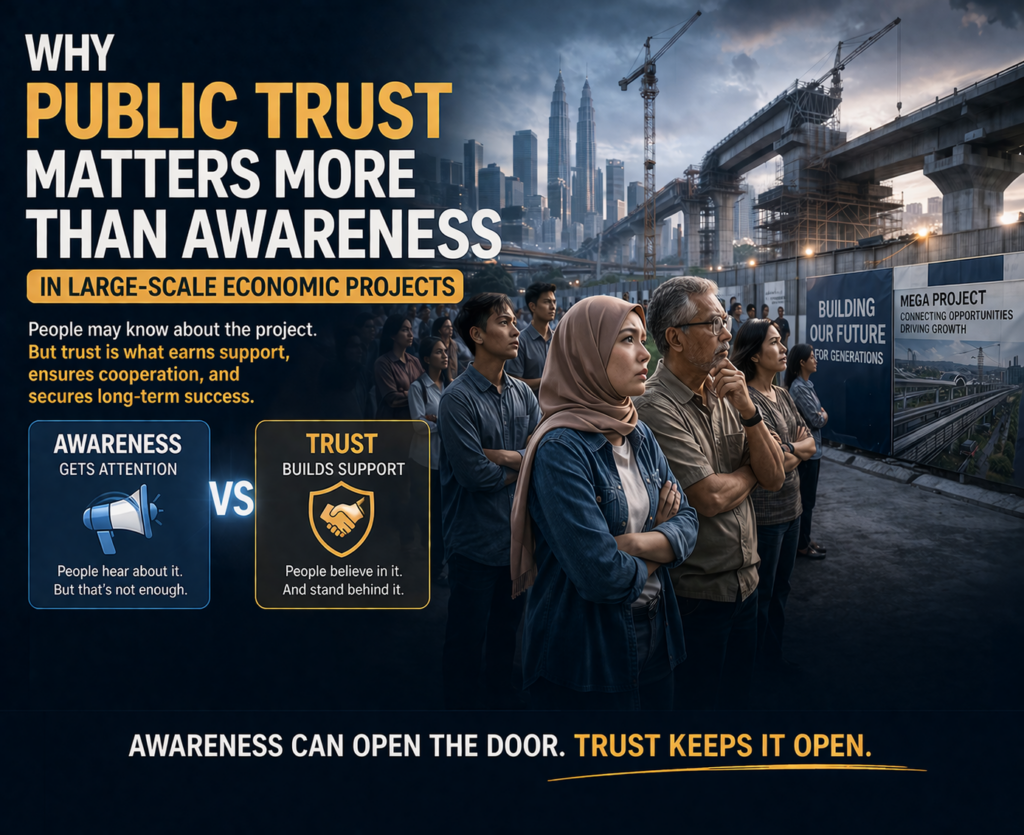
Why Public Trust Matters More Than Awareness in Large-Scale Economic Projects
Mar
When it comes to large-scale economic initiatives, the common assumption is that awareness drives support. The belief is that if people understand the project, they will support it; if they do not, resistance will follow. However, recent findings from Central Force’s JSSEZ study suggest a different reality. Support can exist even when awareness is limited. What matters more is how people feel about the potential outcomes—and whether they trust that those outcomes will materialise.
Awareness Is Not the Same as Acceptance
One of the clearest insights from the study is that awareness does not directly determine sentiment. Despite limited exposure to detailed information about JSSEZ, 87.5% of Johoreans express positive perceptions of its potential. This indicates that acceptance is not necessarily driven by deep understanding. Instead, it is shaped by broader expectations that:
- Development leads to progress
- Investment leads to opportunity
- Growth leads to better living conditions
In other words, people are willing to support what they believe will benefit them, even if they do not fully understand the details.
Optimism Is Real — But It Is Not Guaranteed
While sentiment is largely positive, it is important to understand the nature of this optimism. The study highlights that positive perception is based on expectation rather than lived experience, meaning support is largely untested by real-world outcomes. This creates a fragile form of support. People are open and hopeful, but they are also watching closely. If expectations are not met, sentiment can shift.
Trust Becomes the Key Anchor
In this context, trust plays a central role. When awareness is low, people rely on trust to fill the gap. This trust is built on past experiences with similar initiatives, the perceived credibility of institutions, and confidence that benefits will reach the public. If trust is strong, limited awareness does not prevent support. Conversely, if trust is weak, even high awareness may not be enough.
The Risk of Over-Relying on Communication Alone
A common response to low awareness is to increase communication efforts. While important, communication is not sufficient on its own. The challenge is not just explaining what a project is, but demonstrating what it does. People evaluate development based on visible changes in their environment, tangible improvements in daily life, and access to new opportunities. Without these, communication has limited impact.
The Gap Between Policy Language and Public Understanding
There is a notable difference in how development is described and how it is interpreted. Policy discussions often focus on strategic sectors and investment flows. The public interprets these in simpler terms: Will there be more jobs? Will incomes improve? Will daily life become easier? When these perspectives are not aligned, trust can weaken because people do not see how plans connect to their reality.
Trust Is Reinforced Through Early Outcomes
Trust evolves based on what people observe. Early signals, such as visible infrastructure improvements, available job opportunities, and increased local economic activity, play an important role. When these are present, they reinforce positive expectations. When they are absent or unclear, uncertainty increases.
What This Means for Stakeholders
For policymakers and businesses, building support requires more than awareness campaigns. It requires:
- Translating plans into visible, everyday benefits
- Ensuring early-stage outcomes are tangible
- Communicating in ways that connect with lived experiences
- Monitoring public sentiment as development progresses
Trust is built through consistency between what is promised and what is delivered.
Closing Thoughts
Large-scale economic projects are often evaluated through technical metrics, but from a public perspective, the evaluation is simpler: Does it improve daily life? Does it create real opportunities? Awareness can create interest, but trust sustains support. In the case of JSSEZ, support is present; the challenge now is maintaining it as expectations meet reality.
About Central Force International Sdn Bhd
Central Force International (CFI) is Malaysia’s leading homegrown market research agency, specialising in comprehensive data collection services since 1996. As a trusted partner and member to global organisations such as ESOMAR and WAPOR, we are dedicated to delivering high-quality, ethical, and impactful research insights. With in-house teams for data processing, quality control, and research, CFI ensures every project meets the highest standards of excellence. Guided by our core values—Ethics, Quality, Care—we empower clients with reliable data to drive informed decisions across diverse industries. Visit us at www.cforce-int.com to learn more.