
One Year On, Two in Three Johoreans Still Doubt JS-SEZ
Jan
New report highlights low awareness, conditional optimism, and practical concerns shaping public sentiment on Johor–Singapore Special Economic Zone
Kuala Lumpur, 7 January 2026 —
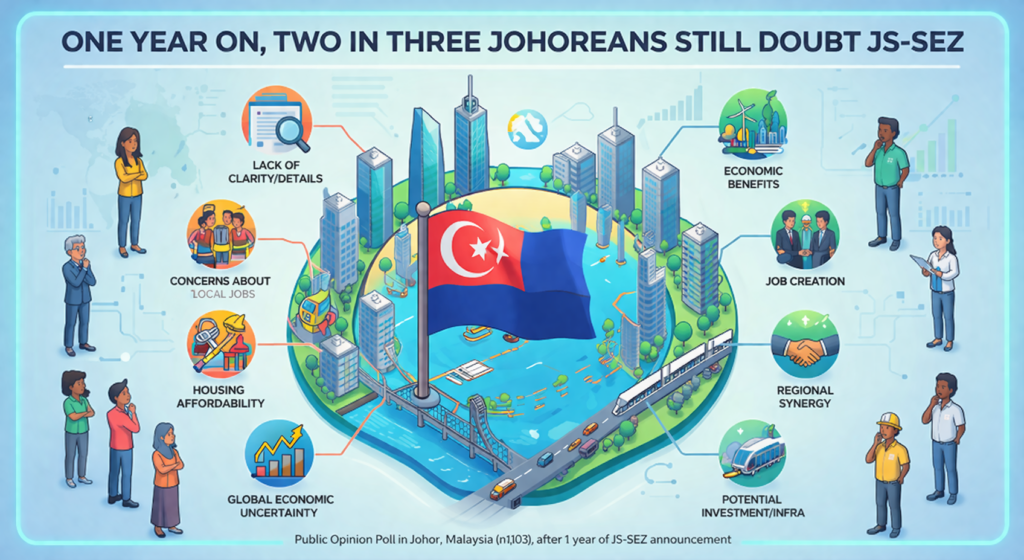
The Johor–Singapore Special Economic Zone (JS-SEZ) was announced one year ago as a landmark project set to reshape the state’s economy and job market. Approved investments for the initiative have already reached RM37.1 billion in the past six months alone. Despite this scale, 64% of Johoreans still don’t know what JS-SEZ is. Is it failing to meet its residents’ expectations?
Central Force International today released the first chapter of its JS-SEZ Public Sentiment Report, which examines how Johor residents actually perceive the initiative. The report highlights what is clear, what is uncertain, and what shapes public support on the ground, offering insights that governments and businesses can use to guide communication, engagement, and operational strategies.
Low Awareness and Fragile Support
Public discussion over the past year has focused on policy frameworks, investment targets, and economic planning. Yet at the ground level, awareness is limited as two-thirds (64%) of Johor residents are still unfamiliar with the initiative. Residents who understand the initiative generally endorse it, while those who are unaware remain neutral rather than opposed. This assures that low awareness does not equate opposition, but it leaves public opinion fragile and vulnerable to rumours, misinformation, or visible disruptions.
The underlying challenge is that JS-SEZ remains largely conceptual. Benefits are not yet visible in daily life, and communication has focused on long-term vision rather than concrete outcomes.
As a result, residents are unsure what JS-SEZ means for them personally. Even supporters are already worried about knock-on effects, such as rising cost of living (23%), rising property prices (14%), traffic congestion (12%), and changes in government (10%).
Perception today will shape acceptance tomorrow. See Toh Wai Yu, CEO of Central Force International stresses that, “Abstract policy statements or projected economic growth have little impact. This fragility persists because most messaging is vision-led and not tied to tangible, local outcomes.”
“We judge development by what we experience in their wallets, homes, and commutes, not macroeconomic statistics. If Johoreans feel priced out, inconvenienced, or uncertain about their prospects, optimism can quickly turn into skepticism,” he added.
What’s Next?
Acceptance of JS-SEZ exists, but it is conditional and fragile. While public narratives have been hopeful, painting a picture of a brighter Johor, policy needs to respond to residents’ day-to-day concerns.
Public opinion can be strengthened with outcome-focused, practical engagement.
Governments should treat low awareness as an opportunity to shape understanding before perceptions harden. Communication should shift from vision-led statements to outcome-focused messaging that highlights local jobs, housing support, and protections for cost of living.
Businesses can complement these efforts by addressing residents’ primary concerns through local hiring, housing support, or mitigating disruptions such as traffic with shuttle services.
View the lite report at
https://www.cforce-int.com/latest-insights.
The full report is available via subscription.
Central Force International is a member of the American Association for Public Opinion Research (AAPOR) Transparency Initiative (TI) and is currently the only Malaysian research organisation participating in this initiative.
— End —