
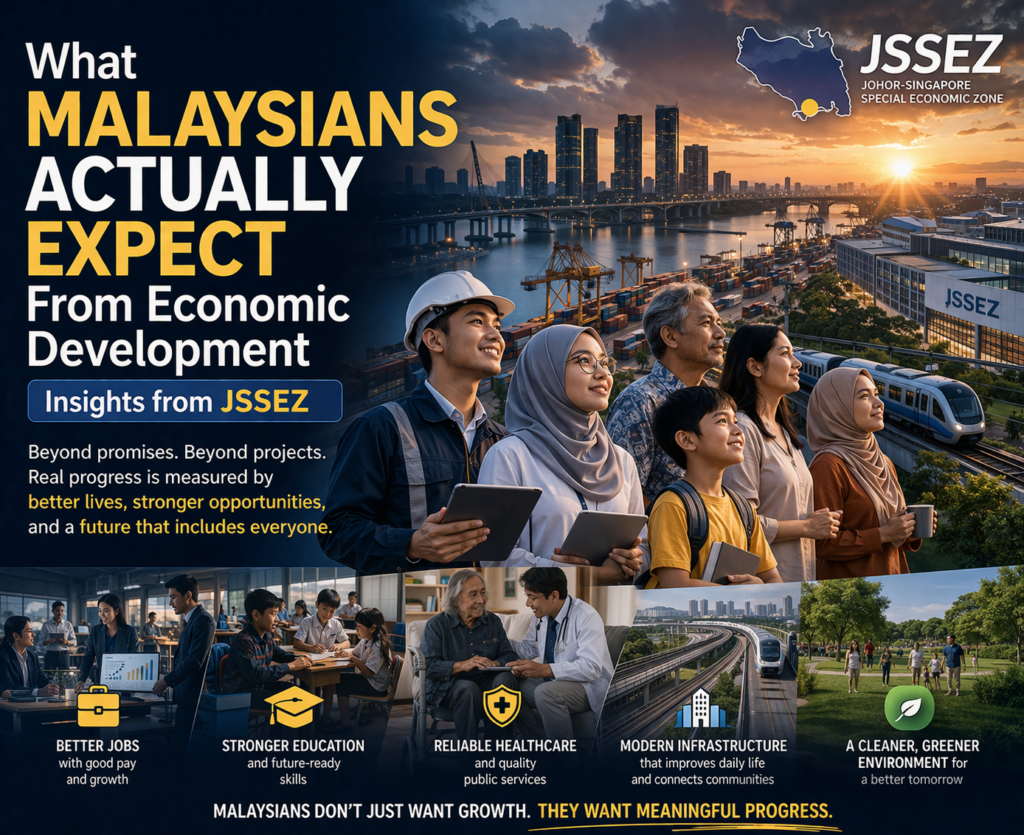
What Malaysians Actually Expect From Economic Development: Insights from JSSEZ
Mar
Economic development is often discussed at a policy level, focusing on investment figures, infrastructure plans, and long-term growth potential. But how these initiatives are received by the public is equally important. Recent findings from Central Force’s JSSEZ study show that while Malaysians, particularly Johoreans, are generally optimistic about development, their expectations are grounded in something much more practical. They are not just looking at what is planned. They are looking at how it affects their daily lives.
Optimism Exists — Even Without Full Awareness
One of the more interesting findings is that awareness is not a prerequisite for positive perception. Despite limited exposure to detailed information about JSSEZ, 87.5% of Johoreans hold a positive view of its potential. Only 9.6% express negative sentiment, while 2.9% remain unsure. This suggests that public sentiment is driven less by deep understanding and more by a general expectation that large-scale development will bring progress. However, this optimism is not unconditional.
Support Is Based on Expected Outcomes, Not Promises
While overall sentiment is positive, it is largely based on anticipated benefits rather than experienced ones. Acceptance is high, but it remains largely untested by real-world outcomes. This creates a conditional form of support. People are open to development, but they are waiting to see whether it delivers tangible improvements, whether benefits are visible and accessible, and whether it impacts their day-to-day lives. In other words, support is not guaranteed. It depends on execution.
What “Progress” Means to the Public
There is often a gap between how development is communicated and how it is interpreted. From a policy perspective, development may focus on high-value industries, foreign direct investment, and strategic economic positioning. From the public’s perspective, progress is understood more simply. Johoreans associate development with job creation, better housing, increased economic activity, and improvements in quality of life.
If development is communicated only in technical or macroeconomic terms, it may not resonate with how people actually evaluate it.
Preferred Development Areas Reflect Practical Needs
When asked what kind of development they want, preferences are spread across several key areas:
- Technology and innovation centres (23.8%)
- Industrial parks (18.6%)
- Tourism-related development (18.0%)
- Housing and property (17.7%)
- Business and commercial hubs (12.5%)
Collectively, these preferences point to a consistent theme. People are looking for development that creates employment, drives economic activity, and improves everyday living conditions. The emphasis is on outcomes that are visible and relevant.
Alignment Gaps Are Often About Communication
Differences between public expectations and official plans do not necessarily indicate resistance. In many cases, they reflect a gap in how development is communicated. For example, government plans may emphasise specialised sectors such as advanced manufacturing or financial services, while the public may interpret these in terms of job availability and income opportunities. This creates a translation gap. The issue is not disagreement, but clarity. When benefits are not clearly understood, support becomes more cautious.
Development Is Evaluated Locally, Not Just Nationally
Another key insight is that expectations vary across districts. Different areas prioritise different forms of development, depending on their local context. However, across these variations, there is still broad agreement that development is expected to be relevant to local needs, deliver tangible benefits, and be visible within the community. This reinforces the importance of tailoring both execution and communication at a more localised level.
What This Means for Policymakers and Businesses
The findings highlight a clear principle: public support for development is not driven by scale. It is driven by relevance. To strengthen alignment, stakeholders should focus on:
- Translating large-scale plans into everyday impact
- Communicating benefits in relatable, practical terms
- Ensuring early wins are visible to the public
- Addressing gaps between expectation and experience
Closing Thoughts
The response to JSSEZ reflects a broader pattern in how Malaysians evaluate development. There is openness and optimism, but also a clear expectation that progress must be felt, not just promised. Support is present, but it is conditional. Ultimately, development succeeds not only through planning and investment, but through how well it aligns with the lived experiences of the people it is meant to benefit.
About Central Force International Sdn Bhd
Central Force International (CFI) is Malaysia’s leading homegrown market research agency, specialising in comprehensive data collection services since 1996. As a trusted partner and member to global organisations such as ESOMAR and WAPOR, we are dedicated to delivering high-quality, ethical, and impactful research insights. With in-house teams for data processing, quality control, and research, CFI ensures every project meets the highest standards of excellence. Visit us at www.cforce-int.com to learn more.