
What’s stressing Malaysians out? Pretty much everything

Oct
It seems Malaysians are stressed about nothing in particular, yet everything in particular. There is something rather Malaysian about the way we deal with stress. We worry about money, work, family and health, but also about politics, wars happening halfway around the world, environmental disasters, changes in our lives and, apparently, spending too much time on our phones. We worry, we complain, we talk about it over coffee, and then someone says tidak apa (Malay expression meaning “it doesn’t matter”, “no big deal”, or “never mind”) and life goes on. All in all, based on the data we are a rather happy-go-lucky lot. Worldwide, 42% of people now report experiencing high levels of stress, up from 32% in 2025. After remaining in the 30 – 33% range for much of the period since 2018, that is a substantial jump. Of note, the most stressed countries this year include Turkey at 70%, Serbia at 61% and Japan at 57%, while Vietnam records just 12%. Overall, the data suggests that the world is getting more stressed. Hardly surprising, as the post-pandemic years have brought economic uncertainty, geopolitical tensions, wars, climate concerns, political divisions, rapid technological change, and an increasingly relentless information cycle.
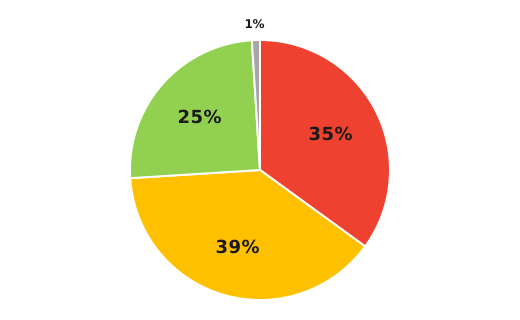
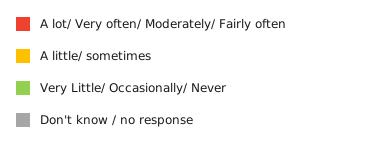
How often would you say that you suffer from stress?
Malaysia, 2026,
(% within total population)
So, are we stressed or are we ̶n̶o̶t̶ stressed?
According to our findings from the latest WIN Worldviews Survey for World Mental Health Day on October 10, the answer is yes, but perhaps not in the way we might expect. Here at Central Force Insights, if anything, we know how to ask the right questions to get the engaging answers, rather than the “tidak apa” answer, which we would mark as ‘No response’. Our latest research fieldwork for 2026 revealed that 35% of Malaysians said they experience stress a lot, very often, moderately or fairly often. That is up from 30% in early 2025, although it remains below the global figure of 42%. In fact, Malaysia sits among the countries with lower levels of high stress surveyed this year.
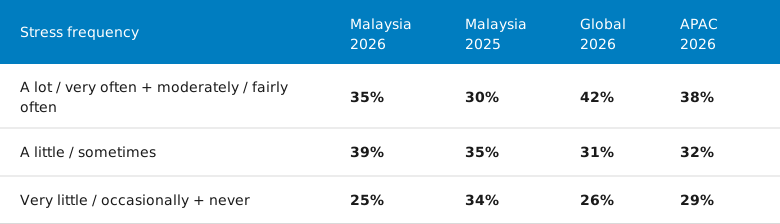
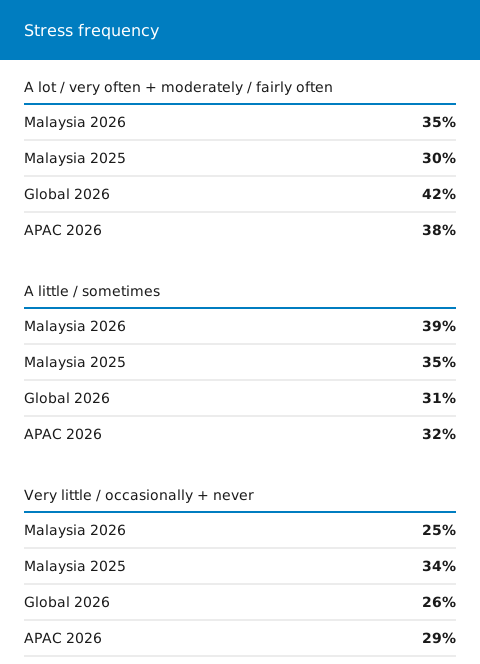
That sounds reassuring, right? You know, the beauty of data is that when you analyse it deeper, it literally tells you a story. Only 25% of Malaysians now say they experience stress very little, occasionally or never. Last year, that figure was 34%. In other words, while Malaysia may not be among the world’s most stressed countries, the number of Malaysians experiencing little or no stress appears to be shrinking. Nearly three quarters of Malaysians now report experiencing at least some level of stress.
And yes, women are feeling it more. Women globally report considerably higher levels of stress than men, with 48% of women reporting high stress compared with 36% of men. And Malaysia shows a similar correlation, although the gap is much smaller. 37% of Malaysian women report high stress compared with 33% of men.
So, what exactly are we stressed about?
If you were expecting one obvious culprit, the Malaysian data does not really give us one. The major sources of stress sit remarkably close together. About 24% of Malaysians cite their job, another 24% cite a lack of employment, while family, money and debts, health and changes in life are all around the 23 – 24% mark. Then there are wars around the world, environmental disasters, politics in Malaysia and even doom scrolling, all sitting between 20% and 22%. Malaysians are not necessarily dealing with one huge source of stress. We seem to be dealing with a collection of pressures across a wide variety of sources. Money is still important. Work is still important. Family is still important. Health is still important. But external factors are making their way into our heads and living rent-free in our minds. Perhaps our famous tidak apa attitude does not mean that nothing is wrong. More likely, it simply means that we have become rather good at saying, “Never mind, we’ll deal with it somehow.”

Money still matters. But perhaps it is not the whole story.
Money and debt are often assumed to be among the biggest sources of stress for Malaysians, and they certainly remain part of the picture. However, the numbers tell an interesting story when we look at our ASEAN neighbours, as well as the global average. While 23% of Malaysians cite a lack of money or debt as a source of stress, the figures are considerably higher in Thailand at 44%, the Philippines at 45%, and Indonesia at 51%. The global average, meanwhile, stands at 32% when it comes to money and debt.
The same goes for work. 24% of Malaysians cited their job as a source of stress, compared with 32% globally. That does not mean Malaysians are carefree about money or employment. Rather, compared with the rest of the world, these pressures do not dominate Malaysian minds to quite the same extent.
We may say the economy is slow and that we are spending less, but we definitely know how to spend. Check out this interesting insight article about spending: We Malaysians say the economy is slow and we are spending less. Yet we are buying more cars?
Politics is stressful. And Malaysia has had plenty of it.
Politics also stands out in our findings. Since 2020, Malaysians have lived through four different Prime Ministers in just over six years. Whatever our political preferences may be, that is a considerable amount of political change in a relatively short period.
Our findings show that 20% of Malaysians cite politics in their own country as a source of stress, while 22% point to global and regional politics. The survey does not necessarily tell us that political change is directly responsible for Malaysian stress, but it does tell us that politics occupies a much more prominent place in the Malaysian stress picture than it does in other countries globally.
Perhaps it is the uncertainty, or the constant news and social media cycle. Perhaps it is simply the exhaustion of having yet another political development to follow. Or maybe, as Malaysians, we just need another reason to debate, argue, or complain about politics with our friends over dinner.
Never mind really. We’ll make it through.
There may be some doom and gloom in these numbers. After all, we decided to write something about stress, and the data does paint a stressful picture. But if anything, the numbers do not necessarily tell us that Malaysians are unhappy. Instead, they remind us that we are human.
We worry, but we adapt. We complain, but we laugh. We get through the difficult days and, sometimes, we do not even realise how well we are doing until we look back. Life has its peaks and valleys, and we often tend to remember the valleys much more clearly. We remember the difficult months, the financial pressure, the argument, the bad news, the job we did not get, or the uncertainty we could not control.
But how often do we stop to notice that we are standing on a peak? The good times spent on outings and over dinners with the family. A hangout with a friend. A quiet evening after a long week. A holiday or concert we have been looking forward to, only to end up recording it on our phones and failing to be in the moment. Or a morning when nothing goes wrong. These moments rarely make the news even though we may post them on social media.
We do not have the answers to all the world’s problems, but we can look out for each other. This World Mental Health Day, ask a friend how they are doing and actually listen to the answer. Check in on someone who has been unusually quiet. Give ourselves permission to step away when everything starts becoming too much.
And perhaps, just for a little while, we can put the phone down. No more doom scrolling. No more checking social media. It’s moments like these that the tidak apa attitude pays off. At least for a day, never mind really.